- Gabriella Garcia@reallygabriella
I run six teams at Warp. Not one of them is engineering. All of them run like engineering teams. Marketing, benefits, people, talent, partnerships, ops. All six on @linear, all six in @claudeai Code. I was a mechanical engineer at Apple, a software engineer at Facebook, then a PM at Google. The most useful thing I took out of all three was watching how those engineering teams worked. Five things they all did: 1/ Everything is written down. Every task has an owner and a state and anyone can go look at it. That sounds like bureaucracy but it does the opposite. Writing work down is what lets ten people work in parallel without a layer of humans in the middle asking each other for updates. 2/ Doing the same thing by hand three times is a bug. An engineer hits the third repetition and writes a script. In ops you can hit the three hundredth and still call it your job. 3/ Deadlines come from breaking the work apart into timed pieces. You cannot put a real date on something you have not decomposed, and the decomposition is the estimate. Every optimistic timeline I have ever been handed was someone skipping that step and hoping. 4/ You ask for the outcome and stay out of the method. People stop coming for permission once the request is clear enough that there is nothing left to ask. 5/ When something breaks, the conversation is about the system that let it break. In engineering that is called a post-mortem. Because of these 5 things, I have changed how my teams operate. Every week, I run a standup with each team around their Linear board. What happened last week, what we are focused on this week, feedback to each other, what is coming. Every engineering org runs this. But almost no operating team does. The usual answer for a high-volume team is to hire an ops person to track the work. I think my people should just be their own project manager. They have ten times the context on what actually matters this week. You lose an entire layer of admin and the prioritization gets better, not worse. None of this would have worked three years ago. The tooling was not there. Now the person who needs the thing can just build the thing, and the work lands in Linear from whoever did it rather than from someone tracking them. The surprise was how fast my team started getting addicted to Linear. Not because they love adding process, but because for most of them this was the first time their work was visible to everyone else. Most operating problems are engineering problems that nobody bothered to engineer.
 How People Use ItAgents & AIRuns six non-engineering teams on Linear and says visibility made them addicted to it.
 - Cristina Cordova@cjc
At the most product-forward companies, the whole company is starting to work like an engineering team. Marketing, recruiting, finance, ops. The work is visible, owned, and increasingly done with agents. t.co/l3aqiKKLfO
@reallygabriella: I run six teams at Warp. Not one of them is engineering. All of them run like engineering teams. Marketing, benefits, people, talent, partnerships, ops. All six on @linear, all six in @claudeai Code. I was a mechanical engineer at Apple, a software engineer at Facebook, then a https://t.co/Hf8CraUKrs
How People Use ItAgents & AIArgues whole companies now work like engineering teams, with visible owned work and agents. - Cristina Cordova@cjc
If Miro had raised $50M total, last at a $20B valuation, and sold for $1.79B in equity value, would we tell a different story about the outcome? They're profitable and still have substantial cash ($435M). The capital wasn’t simply lit on fire. I don’t love overcapitalizing companies, and we’ve chosen not to at Linear when we could have. But "they raised too much" is sometimes a convenient morality tale, not an explanation for why a business with ~$600M in ARR sold for $1.79B.
Darling of 2021, ~20B valuation, 500m raised They don’t tell you this one but “too much capital” is equally likely, if not more, to kill a company than too little You get drunk assuming the party never ends and then boom, you get wiped out https://t.co/2MhZ6TBMWY
Company & TeamArgues overcapitalization is not the real story, noting Linear declined raising more. - Linear@linear
Not all customer feedback is created equal. @CommureOS's product team uses Customer Requests in Linear to weigh it, by count and by revenue. t.co/5lMVw2J3tR
How People Use ItShows how a customer weighs feedback by count and revenue using Linear Customer Requests. - Brendan Carney@brendanrc2
If product quality is an issue that frustrates you at work, here's the #1 way to make a difference: start fixing shit. Don't try to fix the system, have long discussions about it, complain to your manager/peers. At least not yet. Just go. Fix 5+ things every week. Share with your team. Build momentum. Action builds credibility, and you'll get surprisingly far on it alone. Or just come work with me at Linear
Company & TeamSays fixing quality directly builds credibility and invites people to join Linear. - Maciek Pekala@penzington
This was gnarly performance issue, so nice to vibe to it after you've fixed it
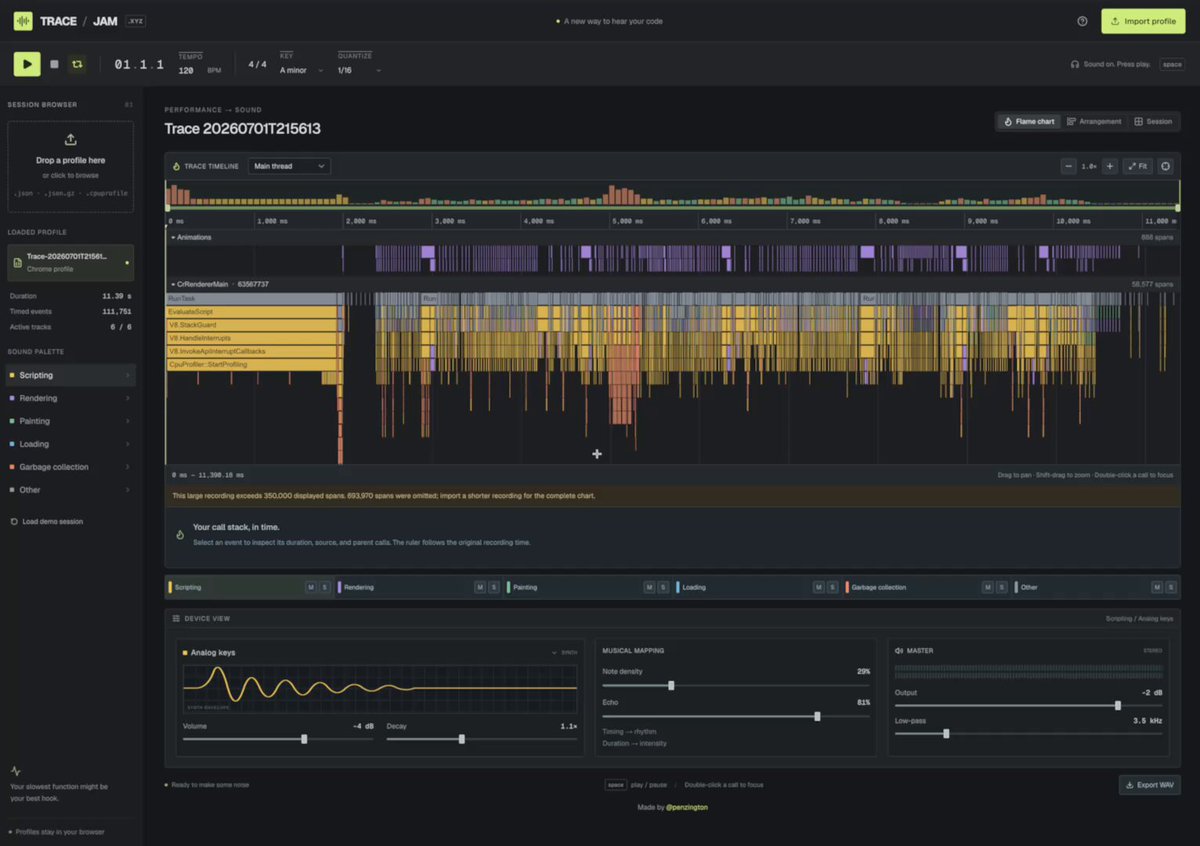 Design & CraftBugs & FrictionCelebrates fixing a gnarly performance issue in Linear.
 - Ahmad Moussa || Gorilla Sun@gorillasu
Made a website that lets you visualize your @linear projects as a connected graph. You just connect a workspace and it shows you all tickets, their status, relationships, etc. Cool to see progress in that manner, and the areas where a bunch of work is left still
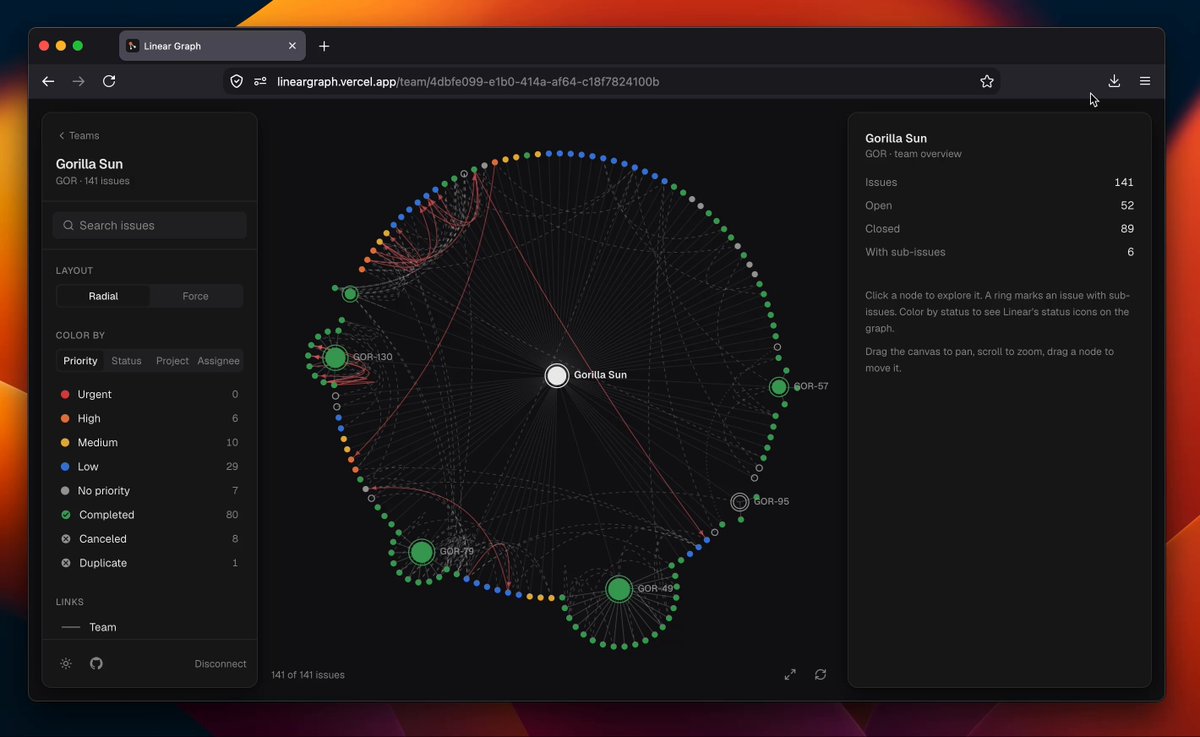 How People Use ItDesign & CraftBuilt a tool visualizing Linear projects and ticket relationships as a connected graph.
 - Mert Deveci@gm_mertd
I found the ideal setup for using Astra and Codex. Here we go: 1. You start with Astra with the prompt: do not edit or write code other than spike tests or bash to get to the bottom of the issue. Goal is to become ironclad on the issue here 2. "Use Linear issues to take notes and use it as a scratchpad. When u are done and 110% sure of issue and solution, make a plan, explicit with which files and where to look in @linear" 3. Now you switch to a new session in GPT-5.6-sol. New session because switching models mid session will invalidate cache, eating into your usage limits 4. You make Sol drive the implementation. If it has suspcisions, you feed it to Astra sipmly Doing this for the last 8 hours ate around 4% of my usage limits. Still a lot, but way better than using Astra only @OpenAIDevs
Agents & AIHow People Use ItUses Linear issues as a scratchpad and plan handoff between Astra and Codex. - tekkac@tek_kac
Managing my team through @linear, constantly updating plans and roadmap was a pain. Not anymore.
How People Use ItPraiseSays managing team plans and roadmaps in Linear is no longer painful. - Vahagn@vahagnzak
We use @linear, so we taught @gruvi_ai Chloe, to use it too. She asks follow-up questions, checks screenshots, files bugs & feature requests, and fetches updates when customers ask. We’ve been using it ourselves. Guess which tracker’s next
 Agents & AIHow People Use ItTaught their AI support agent to file bugs and fetch updates in Linear.
 - Brendan Carney@brendanrc2
Hiring anti-pattern: over emphasizing objective criteria/rubrics. You go too far that direction, team members won't surface important signals outside of it. No one should be afraid to say "i'm just not excited to work with this person"
Company & TeamWarns that rigid hiring rubrics suppress honest signals about candidates. - Doug Parker@dparker313
If any issue frustrates you at work* t.co/H89AVLEhtR
@brendanrc2: If product quality is an issue that frustrates you at work, here's the #1 way to make a difference: start fixing shit. Don't try to fix the system, have long discussions about it, complain to your manager/peers. At least not yet. Just go. Fix 5+ things every week. Share with
Company & TeamJokes that any frustrating issue at work should be fixed immediately.


